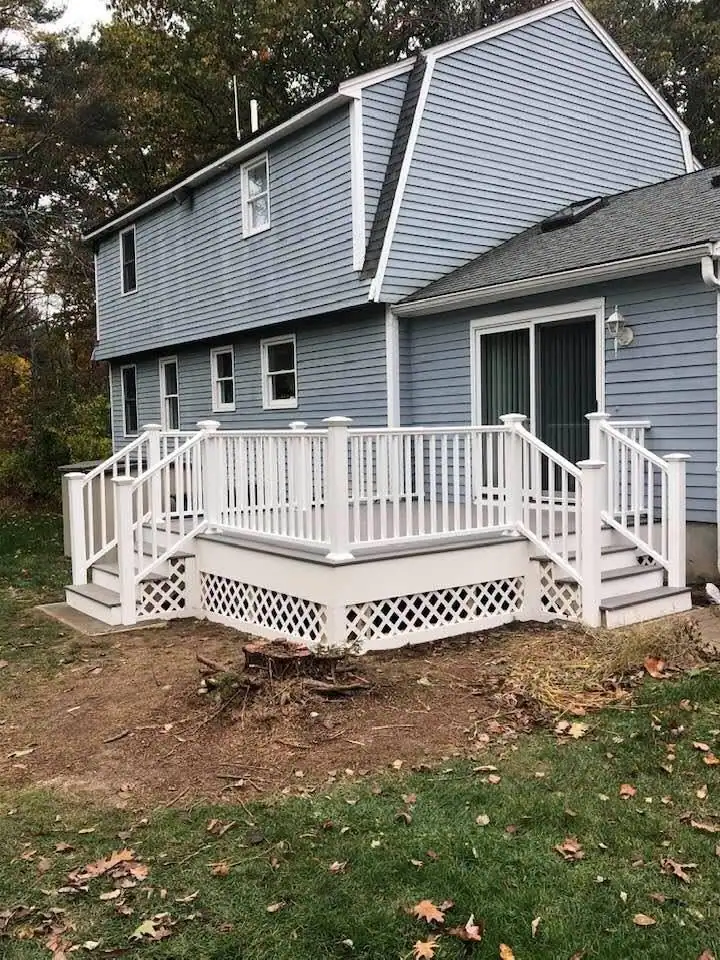
Decks in New England live a hard life. They spend four months as a patio and eight months as a very expensive place to store snow. (We say that with love. We build them.)
Quick answer: Repair your deck if the damage is limited to some boards, a railing or one rotted spot, and the framing underneath is solid. Replace it if the ledger board, joists or posts are rotting, if there's rot in several places, or if the repair would cost more than half the price of a new deck. Wood decks typically last 10 to 15 years.
Extreme Makeover repairs and rebuilds decks, porches and steps around Pelham, NH. One large deck rebuild in 2024 cost the homeowner $18,200 and was done in just over a week.
The 7-sign checklist
| Sign | What it usually means |
|---|---|
| 1. Soft or spongy boards | Repair: replace the boards and check the joist under them |
| 2. Wobbly railings or posts | Repair: re-secure or replace posts and rails |
| 3. Rot in several places | Replace is likely |
| 4. Ledger board rotted, loose or missing flashing | Serious: get it inspected before anyone uses the deck |
| 5. Sagging or bouncy framing | Replace the framing, often the whole deck |
| 6. Leaning posts or heaved footings | Rebuild the footings and posts |
| 7. Wood deck over 15 years old with any of the above | Replacing is usually the better buy |
Grab a screwdriver and a flashlight and you can check most of these in twenty minutes. (Bring a friend too. Not for safety, just so someone hears you say "oh no" in person.)
How long does a deck last?
A traditional wood deck typically lasts 10 to 15 years, and composite decking can last 20 to 25, according to Bob Vila. Age alone doesn't decide it, but it changes the maths: a 14-year-old wood deck with one rotted section is often a better candidate for replacement than a 6-year-old deck with the same problem.
| Decking | Typical lifespan |
|---|---|
| Wood | 10 to 15 years |
| Composite | 20 to 25 years |
| Capped polymer | Up to 50 years |
Source: Bob Vila.
New England doesn't help. Freeze-thaw cycles, wet springs and snow that sits on the boards for weeks all work on the wood. A deck that would coast to 15 years somewhere drier may need attention sooner here.
The 7 signs, one by one
1. Soft or spongy boards
Push a screwdriver into the boards, especially near the house, around planters and anywhere water sits. If it sinks in easily, that board is rotting. One or two soft boards is a repair. Soft boards everywhere means water has been getting into the whole deck, and the joists underneath are worth a look.
2. Wobbly railings or posts
Grab the railing and give it a firm shake. Railings that move are a safety problem before they're a looks problem. Loose rails can often be re-secured; rotted posts need replacing. One of our customers had us "replace rotted wood posts and railings on our front porch". That's a repair, not a rebuild.
3. Rot in several places
One soft spot is a repair. Rot in the boards, the stair stringers and a couple of joists is a pattern. Bob Vila puts it plainly: decks with multiple spots of extensive wood rot may need full replacement.
4. Ledger board trouble
This is the big one, and it gets its own section below.
5. Sagging or bouncy framing
Look under the deck. Joists should be straight, dry and solidly attached. A deck that bounces when you walk on it, or sags in the middle, usually has framing problems that new boards can't fix.
6. Leaning posts or heaved footings
Posts should be plumb, and the footings shouldn't have moved. Frost can push shallow footings up over the years, and a leaning post shifts the load onto everything else. Fixing footings properly means digging, which is why it's rarely a quick job.
7. Age
If your wood deck is past 15 years and showing any of the signs above, replacement usually makes more sense than chasing repairs. You'll likely pay for the same deck twice otherwise. (Once in repairs, once in the rebuild you end up doing anyway.)
If you've ticked more than a couple of these, our deck, porch and steps work shows what a rebuild looks like, from new framing to finished rails.
Why the ledger board matters most
The ledger is the board that attaches the deck to your house. If it's significantly rotted or damaged, "it could result in the deck collapsing," as Bob Vila warns.
The trouble is that ledger rot hides. "Deterioration of components due to water exposure is a leading cause of deck failures," and "the most likely place for hidden decay is at the interface with the house," according to structural engineer David Grandpré in Why Decks Fall Down, published by the American Wood Council. Poor flashing lets water behind the ledger, where it can rot the house's own framing too.
What to check:
- Is there metal or membrane flashing over the top of the ledger, tucked behind the siding?
- Is the ledger bolted or lag-screwed to the house, not just nailed?
- Push a screwdriver into the ledger and the house framing behind it. Both should be hard.
If anything here looks wrong, stop using the deck until someone has looked at it properly. This is the one part of the checklist where "it's probably fine" is not a plan.
The half-cost rule
A simple test from Bob Vila: if the cost of the repair is more than half the cost of a new deck, replacing it may be the better choice. You get new framing, a fresh lifespan and a deck built to current standards, rather than an old deck with new patches.
What does a deck rebuild cost?
Deck prices depend on size, height, materials, stairs and what's going on underneath. A real example: one large deck rebuild by Extreme Makeover in July 2024 cost the homeowner $18,200. The customer wrote that "the quote was reasonable and, upon completion of the project, remained the final price," and that it was "completed in just over a week."
Smaller jobs, such as replacing a run of boards, rebuilding a set of steps or new porch posts and rails, cost a fraction of that. The only honest way to price yours is to look at it, including underneath. Get a free estimate and we'll check the framing and ledger as part of it.
What we actually see on decks around Pelham
- Porches go at the posts. One customer's front porch needed its rotted wood posts and railings replaced, a repair rather than a rebuild.
- Some damage means starting over. As one of our Facebook posts from a job put it: "We've got some deck damage here. Starting the rebuild."
- Small fixes are worth doing early. One customer wrote that we "solved our deck issue" and that it was "not an issue to do small jobs as well as big ones." Catching a problem at the board stage is a lot cheaper than catching it at the joist stage.
The bottom line
Fix the boards and rails when the bones are good. Rebuild when the ledger, joists or posts are rotting, when the rot is in several places, or when repairs would cost more than half a new deck. And check the ledger every spring, because it's the one board that won't tell you it's failing.
See our deck, porch and steps work, or read next: how much a bathroom remodel costs in southern NH.